

Sure, a potential customer expects to hear good things about your products and services from you. But their ears perk up when they hear real customers corroborate those claims. In the same way that a consulting interview relies on concrete examples to prove a candidate’s value, your customer success stories must provide clear, quantifiable evidence that your product or service delivers results.
Enter case studies. They:
- Provide social proof for your product or service’s value.
- Tell prospects in the middle or bottom of your sales funnel real-world, relatable success stories.
- Work wonderfully in the sales funnel process. Marketers say case studies are one of the most effective middle- to late-funnel assets, offering practical interview examples of how you solve problems related to market entry, supply chain optimization and pricing strategy.
But not all case studies are created equal. The best customer success stories fully capture the stakes and show how a product or service helped solve a problem or seize an opportunity.
Ultimately, a case study should help prospective customers with their decision-making process.
Your ability to bring that story to life depends almost entirely on your line of questioning during a case study interview. Think of this process as an elaborate game of 21 questions.
Prevail, and you get an asset that’s sure to help you win new business, influence potential customers and nurture future customers.
Keep reading for interview tips that will help you structure your thought process, refine your interview preparation and improve your overall case study workflows.
Here’s a Look At the Downloadable Version of the Guide:
Download the printer-friendly PDF version here:

Who You Interview Is As Important as What You Ask Them
Choose your brand advocates carefully. Ideally, your interview subject will be a customer who’s highly representative of your target audience, has a strong rapport with your company and can speak to the full implementation process of your product solution.
(Note: You can technically write a case study without the customer’s voice, but even just peppering in direct quotes can make a good case study great.)
Once you have the customer in mind, the first question you should ask is, “What stakeholder can best help me tell this story?”
Ideally, your interview subject will be a customer who’s highly representative of your target audience and future customers.
This is a question for your main client contact. If they aren’t the ideal interviewee, they can probably direct you to the people who were most affected by your brand’s involvement in their business.
With B2C markets, finding the right interview subject is a little more direct in the sense that the customer is an individual and not an organization.
In-Person, via Phone and Video Chat or via Email?
Each interview format has its pros and cons, and your choice can influence the richness of the quotes you gather:
In-Person
Pros:
- Face-to-face interactions.
- Unrehearsed answers.
- Non-verbal cues.
- Rich visual elements (such as physical settings that can be useful for storytelling).
Cons:
- May require travel.
- Some interview subjects might give better answers if they have more time to think about them.
- People often get frazzled or camera-shy in cases of video testimonials.
Phone and Video Chat
Pros:
- Easy to ask follow-up questions or probe for more detail.
- More conversational than email interviews.
- No travel required.
- Easy call recording.
Cons:
- No non-verbal cues if the conference doesn’t include video.
- Harder to interject and control the conversation.
- You don’t get to place the subject in a scene.
Pros:
- Ample time to ponder and answer each question.
- No need to record or take notes since everything is written down.
- Less planning is involved than what’s often required for the other methods.
Cons:
- Less room for conversational back-and-forth.
- Harder to really capture the voice of the person you’re interviewing.
- More pressure to ask the right question every time.
- Responses can be terse or may sound overly formal.
An in-person interview is almost always ideal, and is necessary if you’re creating a video case study or testimonial.
However, video chat or phone interviews work really well for most written case studies that won’t include a video testimonial. The call recording feature is particularly useful for recall and the collection of direct quotes.
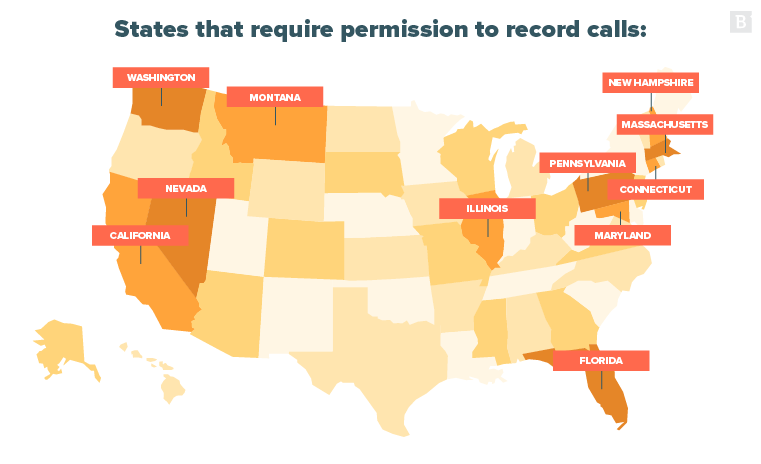
Just remember that some states require permission to record calls:
- California.
- Connecticut.
- Florida.
- Illinois.
- Maryland.
- Massachusetts.
- Montana.
- Nevada.
- New Hampshire.
- Pennsylvania.
- Washington.
Even in states that don’t require permission, it’s a best practice to always ask before proceeding with call recording. Once you’ve started recording, confirm that everyone is okay with it ( so you have a record of consent) and even offer to send every participant a copy of the recording.
Planning Your Line of Questioning
Every case study has a few core components that your questions can be constructed around:
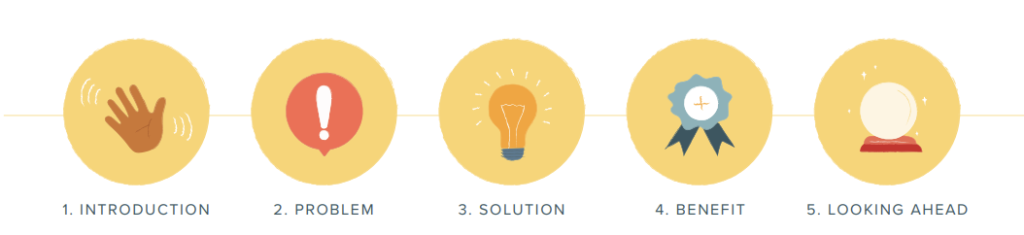
- Introduction: Setting the scene, or providing background on the company.
- Problem: Presenting the key issues that need to be resolved or addressed.
- Solution: The measures taken to solve the problem.
- Benefit: The outcome of those measures, covering quantified wins.
- Looking ahead: How the company continues to benefit, and how it may benefit more in the future.
Try to avoid asking questions that you can easily find online. Remember that you’re taking time out of this person’s day. As an interviewer, it’s important to make the most of the minutes you have with your subject.
Subscribe to
The Content Marketer
Get weekly insights, advice and opinions about all things digital marketing.
Thanks for subscribing! Keep an eye out for a Welcome email from us shortly. If you don’t see it come through, check your spam folder and mark the email as “not spam.”
A Few Key Factors to Keep in Mind
Before we dive into specific case study interview questions, let’s review tips and tricks and general considerations as you plan your interview:
- Write down your questions and the order in which you wish to ask them. You don’t have to stick to this list rigidly, but it can help you get back on track as the conversation meanders.
- Ask follow-up questions as needed.
- Take notes, and be sure to mark the time in the recording when you hear something quoteworthy. It makes your life easier later on.
- Have a sense of the story you want to tell ahead of time. This will help direct the type of information you ask for.
- Ask open-ended questions. They’re great for getting quotes and can be especially useful for the less verbose subjects.
- Get permission to quote the interviewee directly.
- Pivot your angle and tweak your line of questioning as you go if the story turns out to be different from what you envisioned.
- Interject if the interviewee rambles or digresses. You only have so much time to get through your questions.
- Be clever as you dig for quotes. For instance, use a particular phrasing or analogy in a follow-up question. Your interviewee will likely mirror that language in their answer.
- Be sensitive and non-judgemental. This is particularly true for B2C brands, which may be oriented around personal goals as opposed to organizational goals.
- More detail is always better than less. Yes, it’s more to wade through later on, but it’s preferable to learning you don’t have enough when you sit down to start writing.
- Thank your interview subject for their time, as there are almost certainly better things they could be doing with it.
With all of this in mind, let’s move on to some examples of great case study questions.
Note that this is by no means an exhaustive list of questions, and we wouldn’t necessarily recommend asking all of them verbatim. Use them as inspiration to get you started.
Download the PDF: 21 Case Study Questions to Ask Your Satisfied Customers
Background Questions
1. Provide us with an overview of your company and your role and responsibilities in it.
2. How big is your department or your team?
3. Tell us about your target customers and the clients you work with. What do they care about most?
4. What are some of the issues that are unique to the industry you operate in?
Always be on the lookout for follow-up questions that can help color your narrative. If you’re operating in a B2C market, take a similar approach.
Ask open-ended questions to get a foundation of who the customer is. For instance, “tell us a little bit about yourself and your usual buyer journey.”
Problem Questions
5. What drove you to seek out a partnership with our brand?
6. Can you elaborate on some specific pain points you were experiencing?
7. Explain how you were previously dealing with those issues. What was the outcome of those efforts?
8. How did these issues affect morale, efficiency, customer satisfaction, etc.?
The purpose of your problem questions is to fully understand the conflict and what was at stake. B2C brands might ask similar questions with minor adjustments.
For example, instead of asking about morale or customer satisfaction, tailor questions around the challenges they face and any relevant pain points. A mortgage lender, for instance, might ask about some of the concerns that a homebuyer had going into the process, and how they had been dealing with that.
Solution Questions
9. How did you first hear about our products and services?
10. Which products and services did you use? Elaborate on how you used them to help resolve the issues you were experiencing.
11. Were you looking at other vendors? If so, tell us about that process and why you chose us instead. What capabilities made our solution stand out?
12. Tell us about the implementation. How long did it take, and who championed it in your organization?
Learn why they chose your brand, and the capabilities of your products that were most useful for their problem.
This is the problem-solving part of your line of interview questions. Your goal is to:
- Learn why they chose your brand.
- Take stock of the capabilities of your products and what was most useful for the customer’s problem.
- Understand the ease or difficulty of implementing and using certain products.
- Get insights about the quality of customer support and what stakeholders were involved.
Benefits Questions
13. What KPIs or metrics were you tracking throughout implementation (productivity, time-saving, cost, employee morale, etc.)? And what sorts of changes/improvements did you see after using our product/service?
14. What did you do with the time/money/energy saved?
15. What were some of the unexpected or less quantifiable benefits?
16. How was the product/service received among other stakeholders and team members?
17. What did you like most about the experience with our product or service?
Pay close attention to intangible benefits such as less stress, greater employee retention or boosted confidence. Your goal here is to learn how the client measured the value of your product or service.
Try to get them to elaborate on specific results. The more hard numbers and percentages you can get, the better!
Don’t hesitate to request internal reports or documentation, as well as any imagery they might have (if relevant).
‘What’s Next?’ Questions
18. How do you intend to maximize the value that our product or service provides in the future?
19. Tell us about any upcoming initiatives or expanded uses for our product or service.
20. Explain what, if anything, you would like to see added or changed about the product or service.
21. Do you have anything to add that we haven’t covered, or that you think is important for someone reading this to understand about your experience?
Demonstrate how your brand’s value extends beyond the life of just one problem. This part of the case study interview is your opportunity to learn about the longevity of your relationship with the customer.
The Last Word on Case Studies
Remember to break up the copy with plenty of subheads, pull quotes, imagery and bulleted lists. Don’t be afraid to slightly clean up direct quotes as long as you don’t change the meaning of what was said.
If you have follow-up questions or need clarification or insight, you can most likely reach out via email. Once your first draft is complete, share it with your interview subjects. Implement any changes, add in any design elements and begin using the asset as part of your content marketing strategy.
With all the facts and insights of the story in hand, there’s only one thing left to do: Go and write a great case study!
Editor’s Note: Updated January 2026.